Updated October 6, 2026 · Manufacturer-source guidance
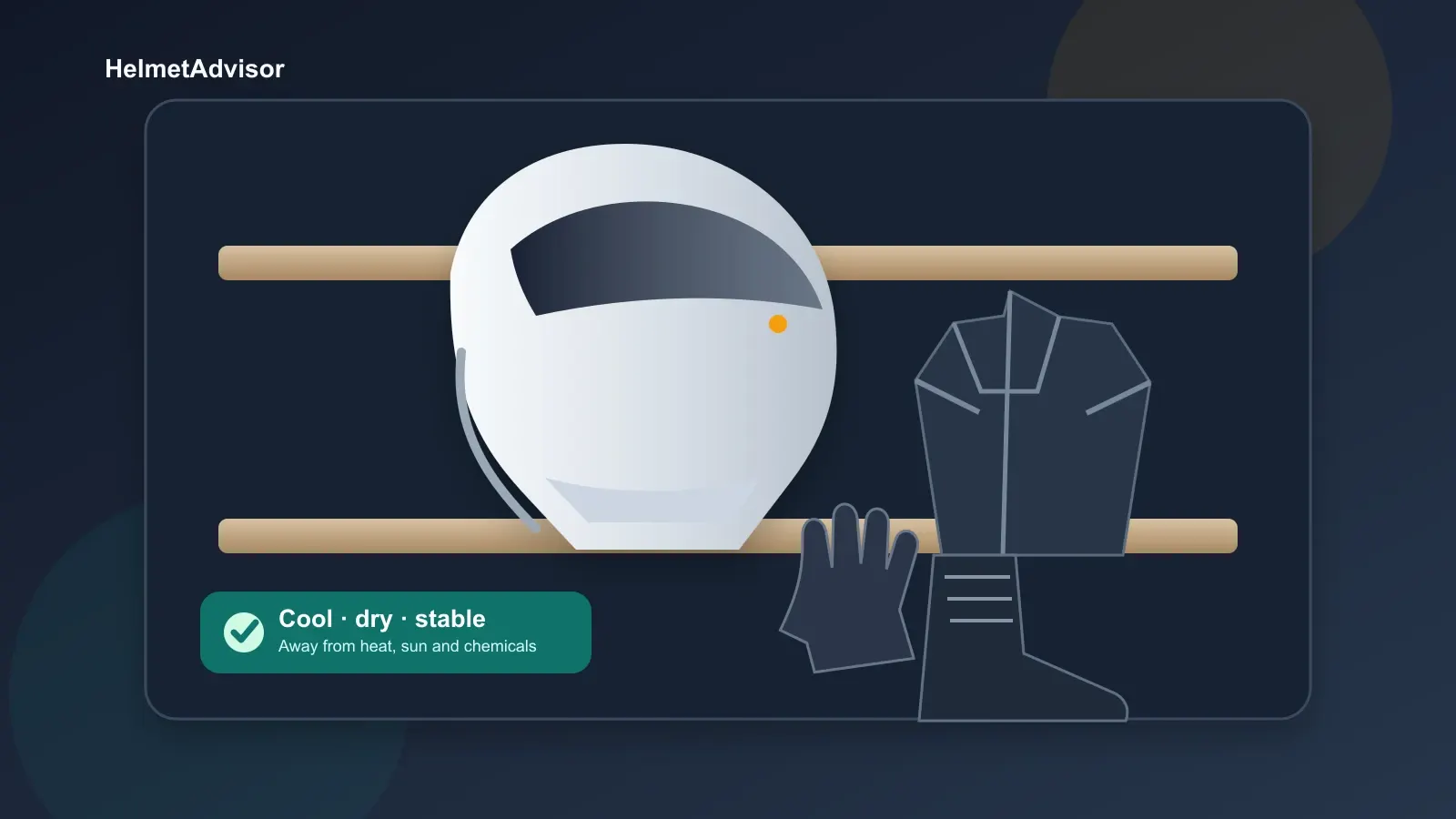
A motorcycle helmet does not need a complicated storage system. The main goal is to protect the helmet from environmental exposure, chemical damage, crushing, moisture and avoidable falls. Several major manufacturers give broadly similar advice: keep helmets dry, avoid strong heat, use manufacturer-approved cleaning methods and keep potentially damaging chemicals away.
Best conditions for storing a motorcycle helmet
| Condition | Recommended approach |
|---|---|
| Temperature | Cool or normal indoor conditions; avoid excessive heat. |
| Humidity | Dry; do not seal away a wet helmet. |
| Sunlight | Avoid prolonged direct sunlight. |
| Surface | Wide, stable and unlikely to let the helmet roll or fall. |
| Chemicals | Keep away from gasoline, solvents, degreasers and fumes. |
| Helmet condition | Clean and fully dry before long-term storage. |
| Bag | Useful once the helmet is dry. |
| Pets / children | Keep the helmet out of reach. |
| Loads | Do not place heavy objects on top of the helmet. |
You do not need a climate-controlled vault. A closet shelf, gear cabinet or clean shelf in a temperature-controlled garage is usually better than a motorcycle seat, sunny windowsill or closed car.
Where should you physically put the helmet?
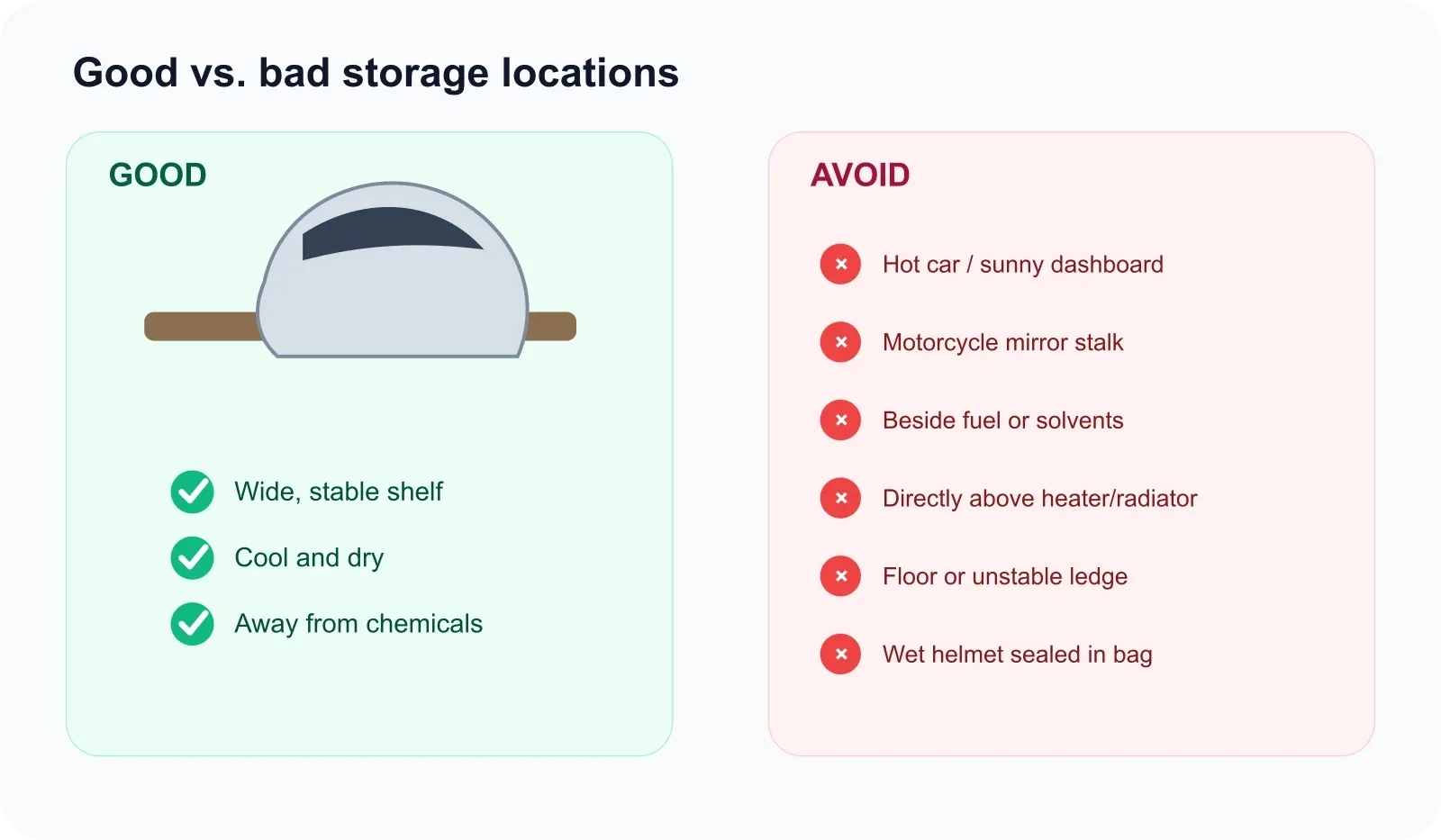
The simplest answer is often the best: a wide, stable shelf. The helmet should not be able to roll, fall, get stepped on or have other gear stacked on top of it.
Good choices
Closet shelf, gear cabinet, wide wall shelf, padded helmet bag placed somewhere stable.
Poor choices
Narrow ledges, motorcycle mirror stalks, seats, fuel tanks, floors, heaters, chemical shelves and sunny car interiors.
Don't store it on a motorcycle mirror
AGV and Arai both warn against placing a helmet over a rear-view mirror stalk or similar narrow support. The concentrated pressure can affect the interior liner. A stable flat surface is a better choice.
Don't balance it on the seat or tank
AGV also warns against leaving helmets on locations such as the motorcycle seat or fuel tank because they can easily fall. The ground is not ideal either: it exposes the helmet to dirt and makes accidental kicks or crushing more likely.
Can you store a motorcycle helmet in a garage?
Yes—if the garage has suitable conditions. A finished attached garage that stays near indoor temperatures is very different from a metal shed that becomes extremely hot in summer or persistently damp in winter.
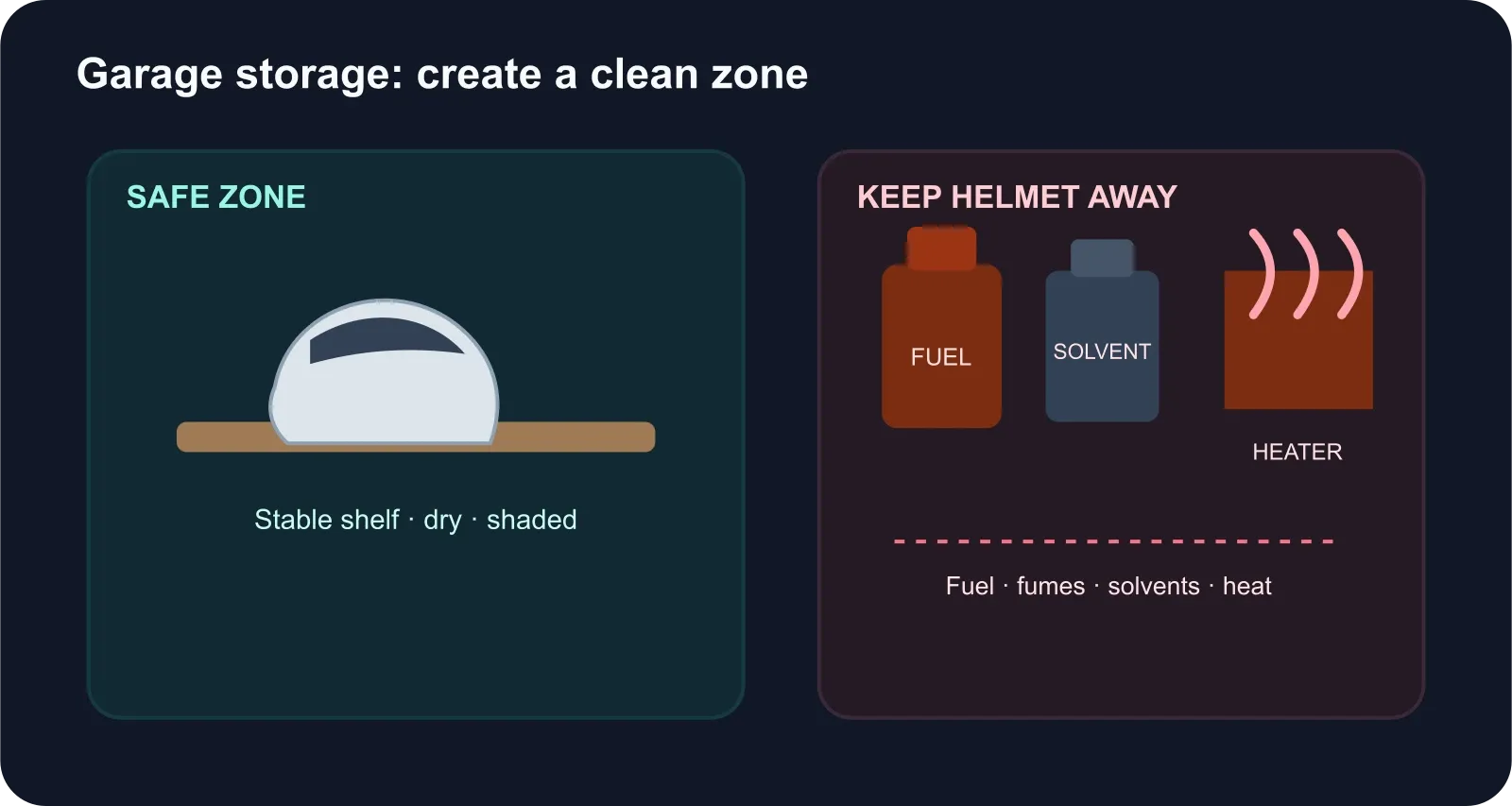
When a garage is a bad place
- Beside gasoline containers, paint thinner or aggressive degreasers.
- Directly above or next to a heater.
- Where strong sunlight hits the helmet every day.
- Where summer heat is extreme.
- Where the space is persistently damp.
- Where rodents or pets can reach the liner.
Quick storage-location check
Good candidate. Use a stable shelf or cabinet where the dry helmet cannot fall or be crushed.
A location check helps plan storage; it cannot assess helmet damage. Follow your helmet’s own manual.
Heat: one of the clearest storage warnings
There is no single temperature limit that should be applied to every helmet from every manufacturer. But HJC specifically instructs owners to keep helmets away from temperatures above 50°C / 122°F and away from hot surfaces. AGV similarly recommends drying at room temperature away from heat sources and direct sunlight.
Can you leave a helmet in a car?
A car is a poor normal storage location, especially in hot weather. Beyond temperature, a vehicle exposes the helmet to sunlight, theft risk and luggage that may roll into or crush it. During transport, secure the helmet in a bag where nothing heavy can be placed on top.
Does sunlight matter?
Helmets are obviously designed for outdoor riding, but that is different from long-term storage in direct sun. AGV warns against very bright sunlight and notes that fluorescent finishes are particularly sensitive to light. A sunny windowsill is therefore unnecessary exposure.
The overlooked problem: moisture
A sweaty or rain-soaked helmet should not go straight into long-term closed storage. Trapped moisture can contribute to odors, mould and liner deterioration.
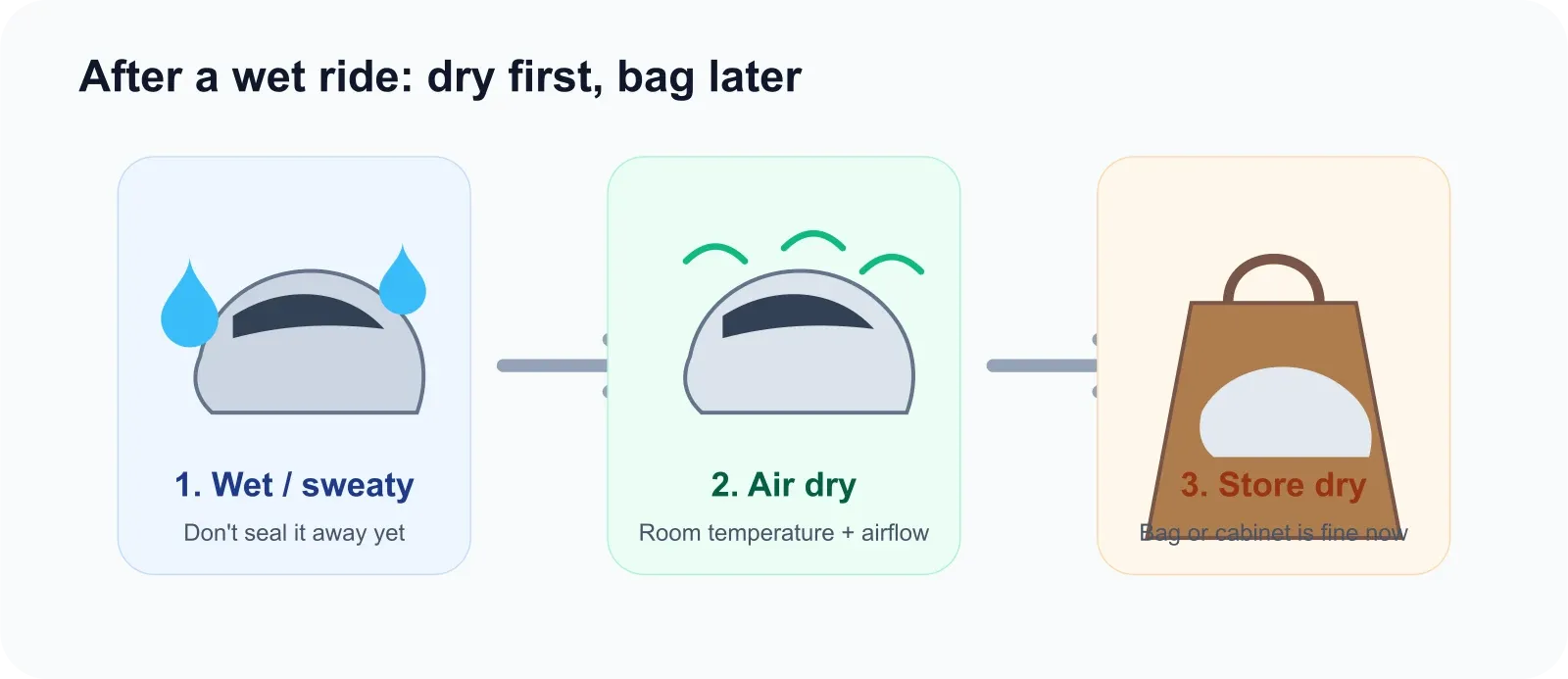
After riding in the rain
- Bring the helmet into a ventilated area.
- Remove removable comfort components if the manufacturer permits it.
- Allow everything to air dry at room temperature.
- Keep it away from radiators, hair dryers and concentrated heat.
- Do not seal it into long-term storage while wet.
After a sweaty ride
You do not need to dismantle the helmet after every commute. Allowing a heavily sweaty helmet to breathe after riding is enough for routine use. Follow your helmet manual for wiping the interior and cleaning removable components as needed.
Should you store a helmet in its bag?
Yes—once it is dry. Helmet sacks and padded bags can protect against dust, light scratches and incidental contact. Padded bags are more useful for car travel and carrying the helmet with other gear.
Cloth helmet sack
Good for home storage, dust and light scratch protection.
Padded helmet bag
Better for transport and additional protection against minor knocks. It still does not make the helmet crush-proof.
Should the visor be open or closed?
There is no universal rule that every motorcycle helmet must be stored with the visor in one position. During drying, airflow can help. For normal storage, keep the visor clean, avoid abnormal stress on the mechanism and follow the specific helmet manual if it gives a storage position.
Fuel, solvents and garage chemicals
This matters because a helmet contains multiple plastics, foams, adhesives, coatings, seals and visor materials. AGV warns against gasoline, benzene, chemicals and solvents. Arai’s general instructions also warn against solvents, including gasoline and their fumes, which can damage the shield, small plastic components and interior.
Don't use random cleaners before storage
Long-term storage is a good time to clean and maintain the helmet, but use the manufacturer's method. AGV recommends neutral soap and warm water as an alternative to its dedicated cleaner and warns against solvents. Arai similarly recommends warm water for its shield rather than harsh chemicals.
A simple daily storage routine
- Check moisture. Is it wet or unusually sweaty?
- Air it if necessary. Give the interior airflow at room temperature.
- Put it away once dry. Use a wide shelf, cabinet or appropriate bag.
- Keep the surroundings safe. No fuel, solvents, heaters or strong direct sun.
For most riders, that is enough.
Long-term and winter helmet storage
If the motorcycle is going away for several months, spend a little more time preparing the helmet.
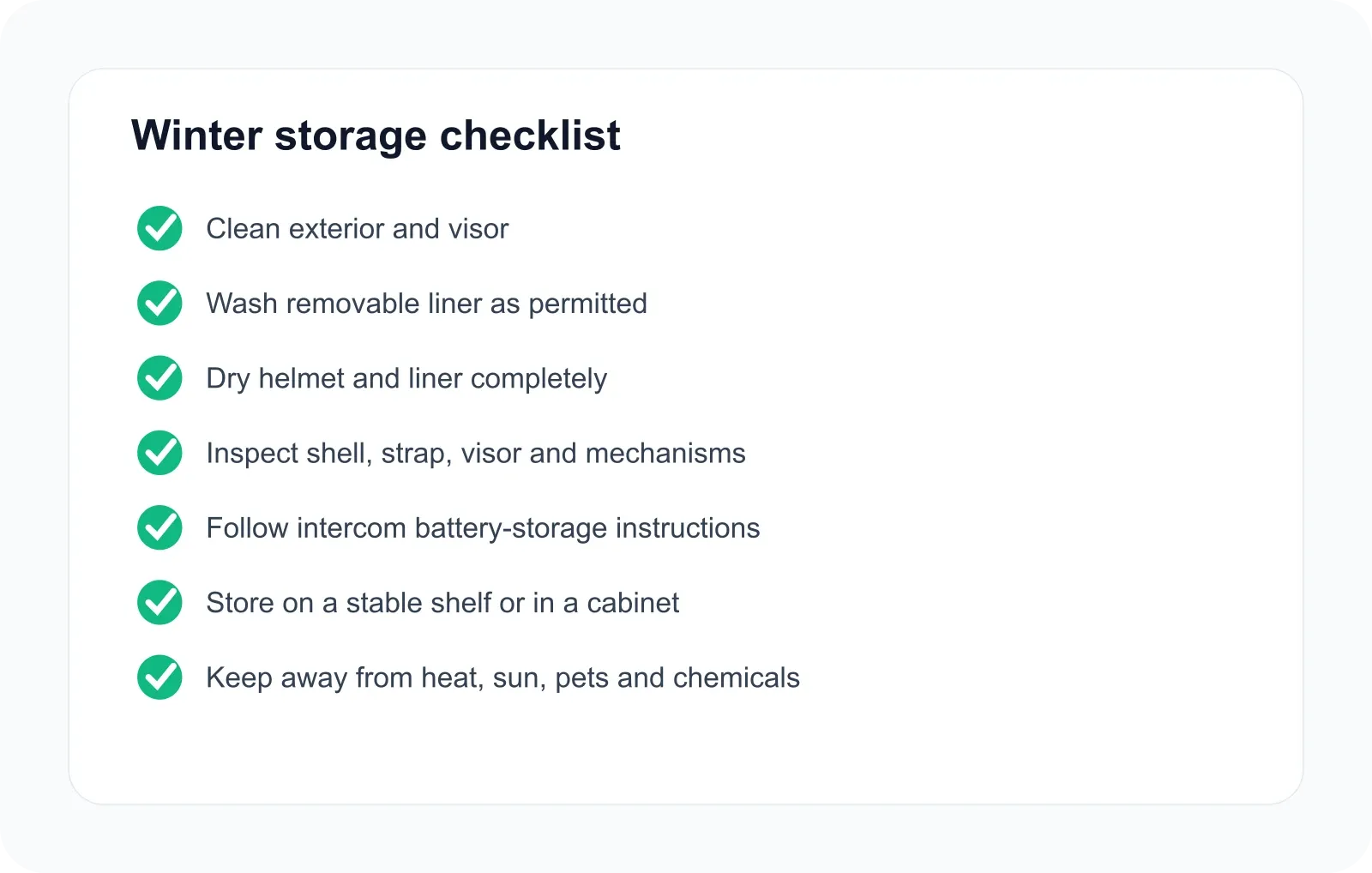
Before storage
- Clean the exterior and remove insects, dust and road grime.
- Clean removable liners according to the helmet manual.
- Dry everything completely at room temperature.
- Inspect shell, visible EPS, chin strap, visor, mechanisms, vents and seals.
- Address the intercom battery according to its own manual.
- Store the helmet on a stable shelf or in a cabinet.
- Use the helmet sack once everything is dry.
Interactive checklist
0 of 8 storage checks completed
What about cold temperatures?
Manufacturer guidance tends to emphasize excessive heat, moisture, sunlight and chemicals much more clearly than normal winter indoor temperatures. A reasonably stable, dry indoor environment is preferable to repeated extreme temperature swings and condensation. If your garage experiences unusual extremes, indoor storage is simpler.
Bluetooth and intercom systems
Helmet storage and battery storage are not the same thing. Cardo, Sena and integrated OEM systems use rechargeable batteries with their own maintenance guidance.
For example, Cardo’s PACKTALK BLACK support page recommends charging at least every three months during non-use. That is advice for that model, not a universal rule for every intercom; check your own unit’s manual.
- Identify the exact communication-system model.
- Check its manual for long-term storage.
- Charge or remove detachable modules only as instructed.
- Do not disassemble non-user-serviceable battery systems.
Storing a helmet while traveling
Hotel room
Use a wide desk, closet shelf or padded bag in a location where the helmet cannot be stepped on or knocked from a narrow ledge.
Car
Use a helmet bag and position it so that luggage cannot crush it.
Motorcycle helmet locks
A helmet lock may help with theft risk, but it does not protect against rain, exhaust heat, dirt or someone knocking the helmet against the motorcycle. Arai warns against carrying a helmet on the motorcycle's helmet lock while riding because of potential exhaust, tire and strap damage.
Keep it away from the exhaust
Arai instructions specifically mention the possibility of exhaust-pipe burns when helmets are carried improperly. Be aware of exactly where a locked helmet hangs.
Pets can damage a helmet
HJC and Arai both warn about animal exposure. Foam and liners can be scratched or chewed; a closed cabinet is an easy solution.
What if the helmet falls from a shelf?
An empty helmet falling from a modest shelf is not the same event as the helmet striking the road while protecting a rider's head. But you should not assume every drop is harmless.
Consider how far it fell, what surface it hit, which part struck first, whether anything heavy was inside it and whether the shell, visor mechanism or visible EPS shows damage.
What if it was involved in a crash?
That is different from an empty storage drop. A helmet that sustained a significant impact while being worn may have absorbed energy through the EPS liner even if the exterior still looks acceptable. Shoei recommends replacement after significant impact and notes that internal damage may not be visually obvious.
Does a helmet age while sitting in storage?
Storage does not make a helmet indefinitely usable. Useful life depends on age, use, exposure, impact history, material condition and manufacturer guidance.
Helmet replacement periods are manufacturer-specific, not a universal legal rule. Shoei currently recommends replacement five years after first retail purchase even when none of its other listed replacement conditions applies. That does not mean every helmet from every brand universally expires at exactly five years.
Can an unused helmet be kept indefinitely?
Do not assume so. An unused old helmet may still have an unknown storage history, aged components, outdated certification or unnoticed handling damage. If you find a supposedly new helmet that has been stored for many years, check its manufacture date, storage history, model age and the manufacturer's current guidance.
What to inspect after long storage
Shell & EPS
Check for cracks, deformation and visible damage without dismantling structural components.
Interior
Look for mould, deterioration, loose attachments or badly compressed padding.
Retention system
Inspect chin strap, stitching, buckle or D-ring operation.
Visor & mechanisms
Check clarity, scratches, chemical damage and smooth operation.
Put the helmet on again. If the comfort liner has compressed so far that the helmet now moves excessively, long storage did not preserve correct fit.
Where not to store a motorcycle helmet
| Place | Why avoid it |
|---|---|
| Hot car | Potential excessive heat and direct sunlight. |
| Motorcycle mirror | Narrow support can concentrate pressure on the interior. |
| Seat or fuel tank | Easy for the helmet to fall. |
| Beside gasoline or solvents | Potential chemical and fume exposure. |
| Radiator / heater | Unnecessary concentrated heat. |
| Damp basement | Poor environment for a textile-lined safety product. |
| Sunny windowsill | Prolonged light and heat exposure. |
| Floor | Easy to kick, step on or contaminate. |
| Under other gear | Helmet is not a shelf or storage bin. |
| Within pet reach | Liners and foam can be chewed or scratched. |
Frequently asked questions
What is the best way to store a motorcycle helmet?
Keep it clean and dry on a stable shelf or in a cabinet, away from excessive heat, prolonged sunlight, chemicals and anything that could make it fall. Once dry, a helmet sack or padded bag can add dust and scratch protection.
Should I keep my helmet in its bag?
Yes, once it is dry. Do not seal a wet or heavily sweaty helmet into long-term storage.
Can I store my helmet in the garage?
Yes, if the garage is reasonably cool and dry and the helmet is kept away from fuel, solvents, fumes, direct sunlight and excessive heat.
Can I leave my helmet in a hot car?
A hot car is a poor long-term storage location. HJC specifically warns against helmet exposure above 50°C / 122°F.
Can I put my helmet on the motorcycle mirror?
It is better not to. AGV and Arai warn against using mirror stalks because they can affect the interior liner.
Should I leave the visor open?
There is no universal storage position for every helmet. During drying, airflow can help; for normal storage, avoid stressing the mechanism and follow the helmet manual.
How should I store a wet motorcycle helmet?
Let it air dry at room temperature before putting it into a closed bag or long-term storage. Avoid direct heaters and hair dryers unless the manufacturer explicitly permits them.
Is a helmet ruined if it falls off a shelf?
Not automatically. Inspect it and contact the manufacturer if you are uncertain, especially after a significant drop or if anything heavy was inside it.
Does an unused motorcycle helmet expire?
Manufacturers provide their own service-life guidance. Do not assume storage makes a helmet indefinitely usable.
Can I store a helmet next to gasoline?
Avoid it. Arai warns about gasoline and gasoline fumes, and AGV warns against gasoline and other solvents.
Keep storage simple
Proper helmet storage is not complicated. Think cool + dry + stable + clean + away from chemicals.
Do not leave the helmet baking in a hot car, balance it on a mirror, seal it away wet, store it beside gasoline or let luggage, pets or children damage it. For everyday use, let it air after riding and put it on a stable shelf. For winter storage, clean it, dry it completely, inspect it, store it somewhere protected and handle rechargeable electronics according to their own manuals.
Sources and methodology
This guide prioritizes manufacturer care and maintenance instructions rather than generic storage folklore. Manufacturer instructions for your exact helmet take priority where they differ from general guidance.
- HJC Helmet Care / Cleaning: cool and dry storage, animal exposure, and warnings concerning heat above 50°C / 122°F. hjchelmets.us
- AGV Product FAQ: air drying, solvents, direct sunlight, mirror/seat/tank placement and care. agv.com
- Arai General Instructions: solvent and gasoline-fume warnings, mirror placement and handling precautions. araiamericas.com
- Shoei Helmet Maintenance: replacement criteria and service-life guidance. shoei-helmets.com
- Shoei Impact Inspection: impact-inspection guidance for qualifying helmets. shoei-helmets.com
- Cardo Support: model-specific rechargeable-battery maintenance guidance during periods of non-use. cardosystems.com
Related helmet care guides
- How to clean and maintain a motorcycle helmet
- When to replace a motorcycle helmet
- Helmet fit, sizing and head shape
Illustrations: original artwork supplied for this guide.