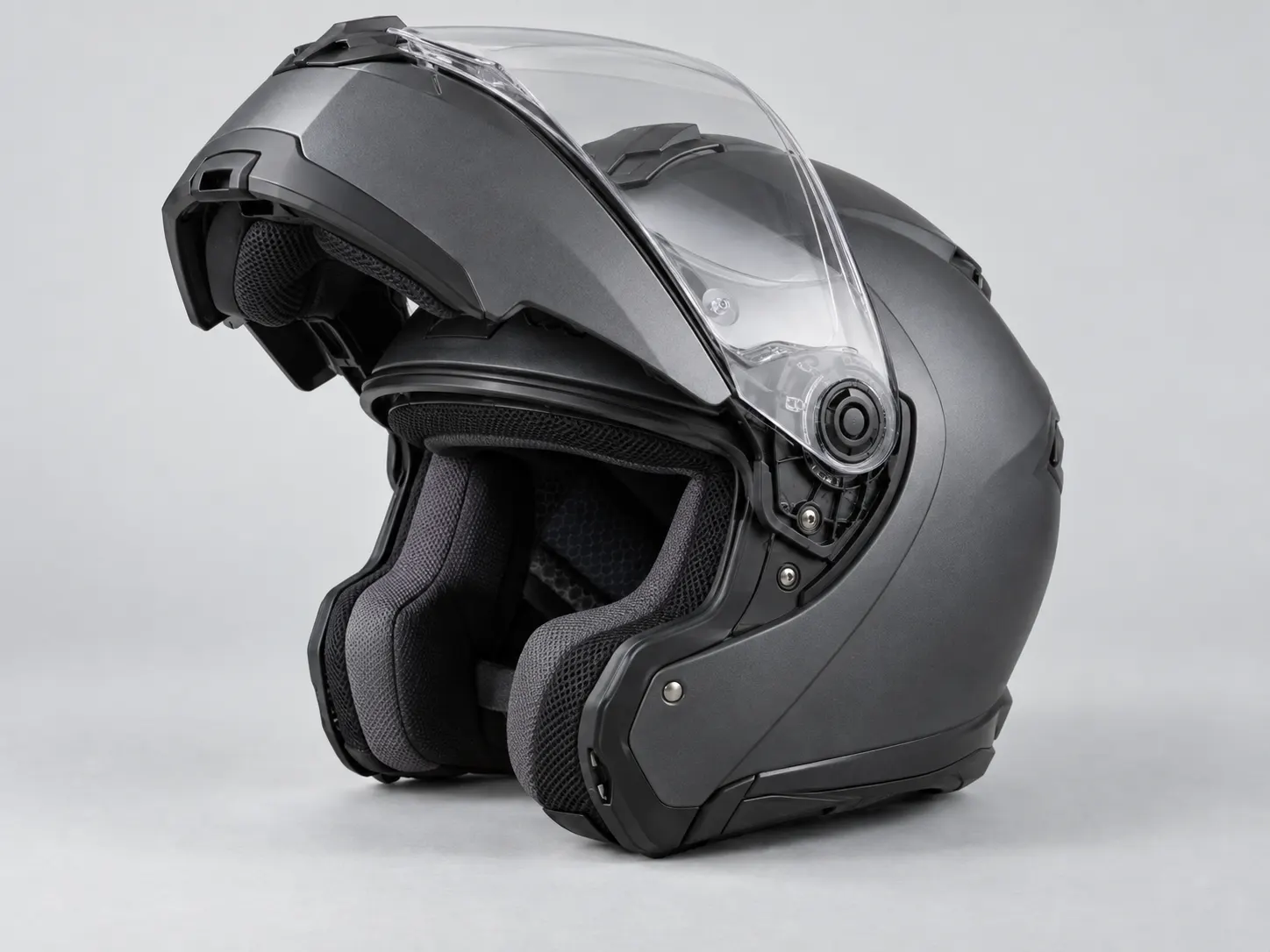
Illustrative image—not the exact model.
Shoei Neotec 3
By Jack Rydell
The Shoei Neotec 3 combines a flip-up chin bar with an internal sun visor. Start by selecting the market you are buying in, then assess the fit and the complete accessory package. European and US listings belong in separate specification records.
Who should consider it
Touring and everyday riders who want a flip-up chin section, an internal sun visor and the option of an integrated communications installation.
Features and trade-offs
Use the regional specification panel for the sourced shell, fastening and approval details. The equipment notes below explain the controls and accessory choices to check during a fitting.
The SRL3 is an additional purchase. A modular mechanism is useful only if its controls and closed fit work for you; try a fixed-chin helmet alongside it before committing.
What to check at a fitting
Open and close the chin section while stationary, confirm the locks engage and check glasses clearance with the QSV-2 lowered. Try the adjusted strap with your jacket collar.
Start with the manufacturer’s size chart and keep the helmet on long enough to identify pressure points. Follow the model’s fitting instructions and repeat the retention checks after any approved adjustment. Record the size and padding configuration that works for you.
Use the helmet fit checklist before comparing accessories.
Two alternatives to try
- Schuberth C5 (EU). Touring riders seeking a modular helmet with a sun visor and preparation for the SC2 communications system.
- Shoei GT-Air 3 (EU). Touring riders who want a fixed chin bar with a built-in sun visor and optional SRL3 communications.
Compare these three helmets. Keep the version labels visible when considering models from different markets.
European specification
Shoei Europe lists an AIM shell, ECE 22.06 P/J approval, a stainless-steel micro-ratchet fastener, a CNS-3C outer visor and QSV-2 sun visor. Its package list includes a Pinlock sheet, breath guard and chin curtain. European model and package details.
The published European weight is 1,700 g. Shoei’s measurement guidance specifies a plain-colour size M helmet and a ±50 g tolerance; graphic finishes can weigh more. This is manufacturer data, not a measurement of a purchased sample. Weight measurement guidance.
US specification
The US product listing identifies DOT certification and an AIM shell. Shoei USA also documents the micro-ratchet fastening and QSV-2 sun visor. Its listed 4.15 lb weight lacks a stated size in the cited product listing, so the standardized US weight remains unfilled. Do not apply the European size-M value to a US helmet. US specification listing; US equipment details.
Plan the accessory package
Shoei Europe identifies SRL3 as a compatible communications option sold separately. When comparing prices, ask whether the quoted offer includes the intercom and installation. Communications and supplied accessories.
Build a quote around your intended use: helmet, any approved fit adjustments, the communications kit if needed, and replacement visor availability. Have the seller confirm each part number. An attractive helmet-only price is not enough to compare two complete setups.
What to check at a fitting
- Use the exact model’s size chart, then follow our fit and sizing checklist.
- Try your glasses with the visor and sun visor in their working positions while stationary.
- Demonstrate fastening and chin-bar operation back to the dealer after the initial explanation.
- Ask which approved pad options are available if an adjustment is needed, and repeat the fit checks after any change.
- Record the model, market, size and agreed configuration before ordering.
Shoei offers alternative padding and dealer fitting support; its FAQ explains how to access those services. Padding and fitting options.
Choosing between the Neotec 3 and C5
Bring the same shopping checklist to both fittings. Compare the comfort of the adjusted strap, your ability to use the controls and the full written quote. Our C5 vs Neotec 3 comparison covers the European versions. For a fixed-chin alternative, see the Neotec 3 vs GT-Air 3 comparison.
This overview uses published documentation. It does not assign a noise or comfort score from manufacturer descriptions.
Sources
- Shoei Europe: Neotec 3
- Shoei Europe: weight and fitting FAQ
- Shoei USA: Neotec 3 specifications
- Shoei USA: Neotec 3 equipment
This is a documentation-based buying guide. Fit, noise and comfort have not been scored from hands-on testing.
Helmet specifications
Regional specifications are kept separate. Unknown values are not estimated.
European version
- Model / market
- Neotec 3 · EU
- Manufacturer-listed certifications
- ECE 22.06, P/J
- Shell
- AIM
- Internal sun visor
- Yes
- Fastening
- Stainless-steel micro-ratchet
- Manufacturer weight
- 1700 g — Manufacturer: plain-colour size M, ±50 g; graphic finishes may weigh more. European model.
P/J denotes the stated jet/full-face homologation categories; it does not mean an open chin bar provides the same facial coverage as a closed one.
US version
- Model / market
- Neotec 3 · US
- Manufacturer-listed certifications
- DOT
- Shell
- AIM
- Internal sun visor
- Yes
- Fastening
- Stainless-steel micro-ratchet
- Manufacturer weight
- Not verified
US listing. European ECE/P-J approval is not transferred to US helmets. Manufacturer weight lacks size context in the cited listing.
Japanese version
- Model / market
- Neotec 3 · JP
- Manufacturer-listed certifications
- JIS (revision not specified)
- Shell
- AIM+ (Advanced Integrated Matrix Plus Multi-Fiber)
- Internal sun visor
- Not verified
- Fastening
- Not verified
- Manufacturer weight
- 1699 g — Size L, solid colour; manufacturer's production average, excluding supplied accessories
Japanese-market specification. The manufacturer lists JIS and AIM+ for this version; EU and US approvals are not carried over. Weight varies by size and graphic finish.
Certifications are not comparative safety scores. Check the label on the exact helmet; production versions and market approvals can differ.