Plan the move around your motorcycle’s parking, daily route, paperwork and transport.
The best time to find a motorcycle problem with a new home is before you sign a lease, commit to a property or hand the bike to a transporter.
This checklist focuses on the questions that are easy to miss in an ordinary move: whether the advertised parking really works for a motorcycle, whether the route changes what you need from your gear, and what to document if the bike travels separately.
1. Before choosing a home: do a 15-minute motorcycle check
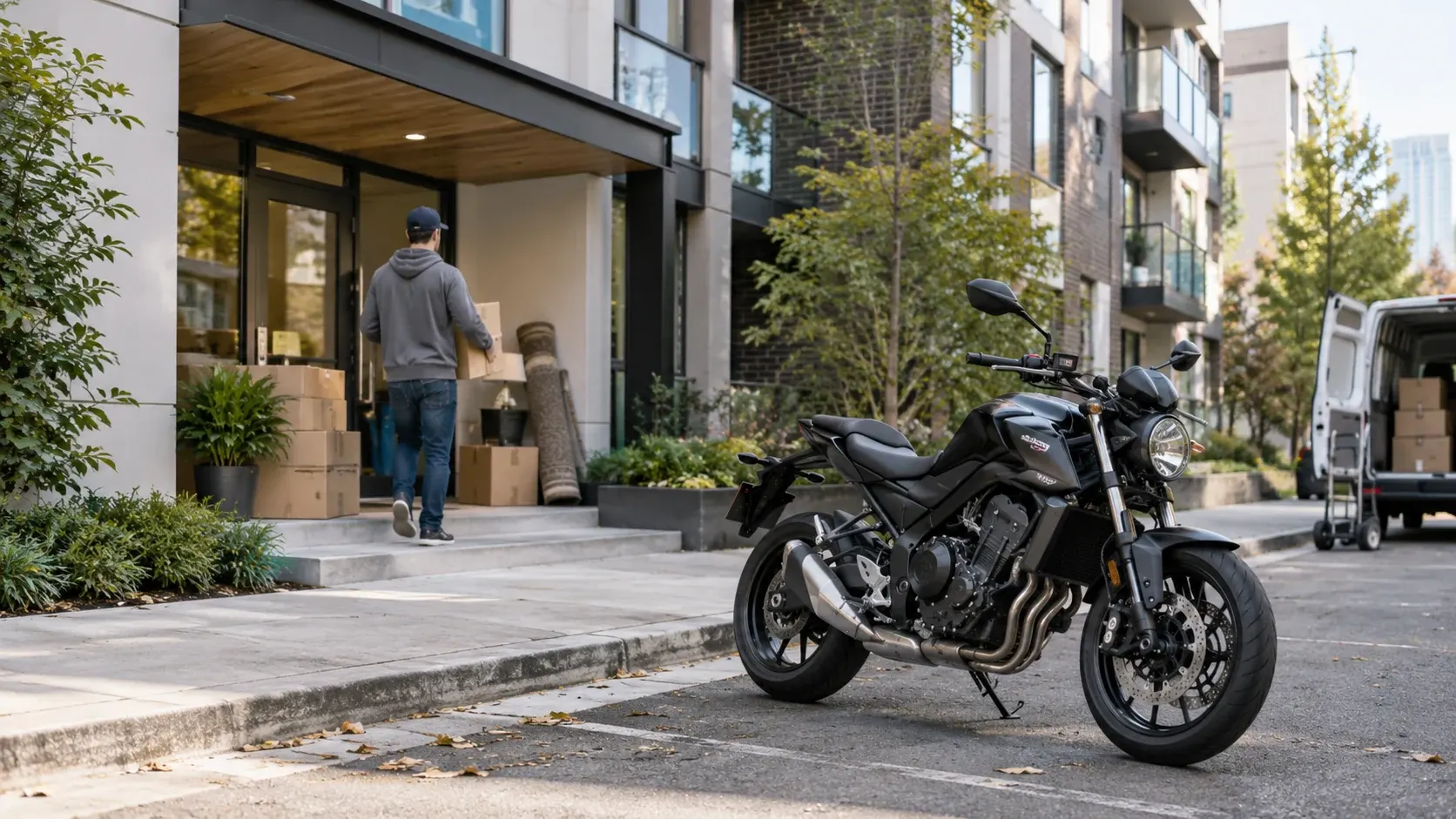
A listing that says “parking included” does not tell you whether that parking is assigned, whether motorcycles are allowed, whether a car and bike can share the space, or whether the entrance works for your motorcycle.
Before committing to a property, verify the details directly with the landlord, building manager, HOA or property owner.
| Check | What to ask |
|---|---|
| Motorcycle parking | Are motorcycles specifically permitted in the parking area? |
| Assigned space | Is the space assigned to you or first-come, first-served? |
| Car + motorcycle | Can both occupy one assigned space, or is a second space required? |
| Access | Can the motorcycle comfortably pass through the gate, ramp and entrance? |
| Hours | Can you enter and leave whenever you normally ride? |
| Security | Can you use your normal locks, chain or other security equipment? |
| Anchor points | Is attaching equipment to a floor, wall or fixed structure permitted? |
| Weather | Is the bike indoors, covered, partially covered or exposed? |
| Maintenance | Does the property prohibit washing or maintenance in the parking area? |
| Visitors | Where can another rider park when visiting? |
2. Research the journey you will actually ride
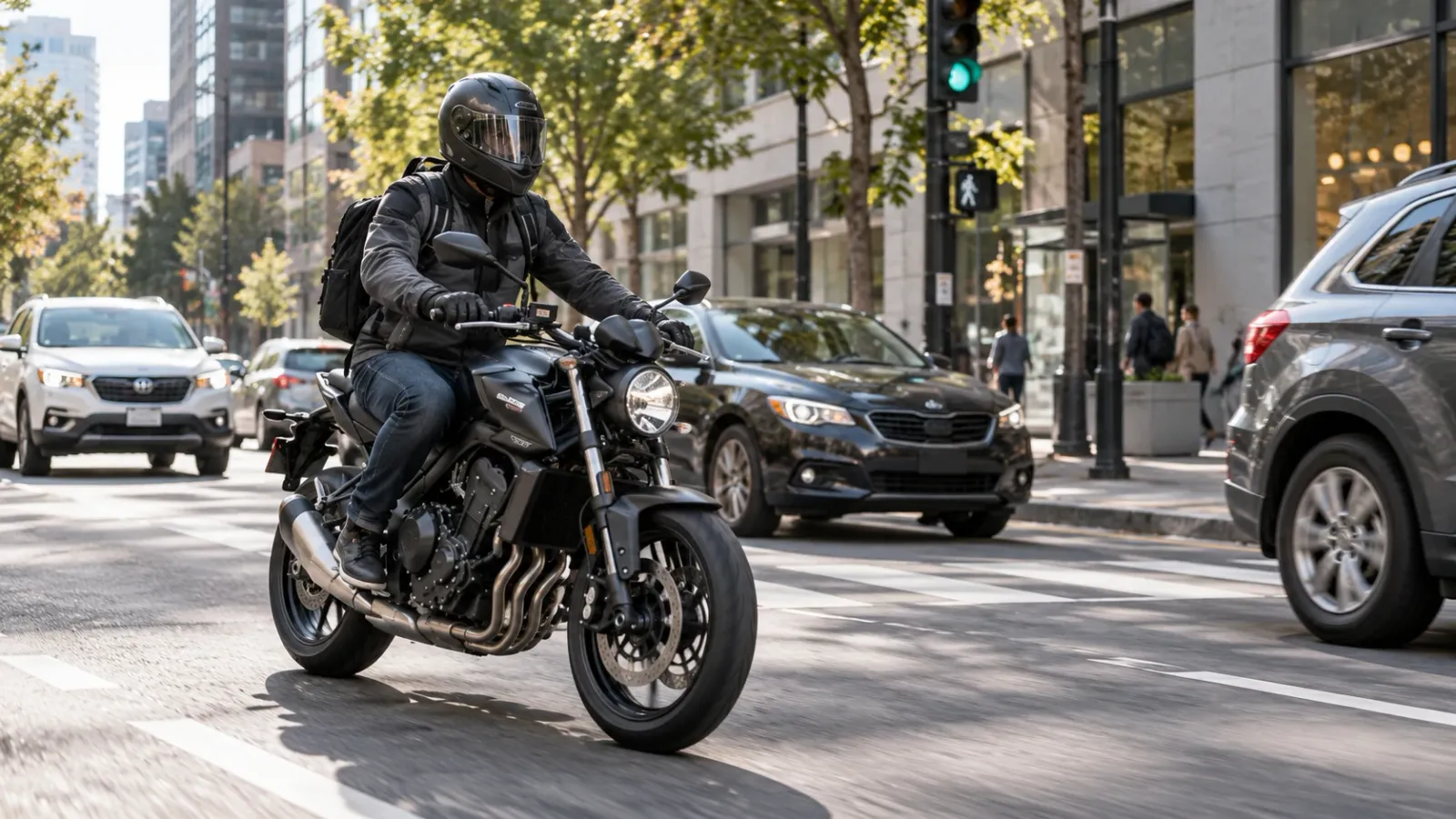
Distance alone is a weak description of a commute. Two homes can be the same distance from work while producing very different riding: one may be slow urban traffic with sheltered parking; another may add sustained faster roads, poor-weather exposure or awkward destination parking.
For each serious home candidate, record:
- approximate door-to-door distance;
- travel time at the hours you normally commute;
- how much of the route is local streets versus faster roads;
- whether the obvious route regularly becomes congested;
- whether useful alternative routes exist;
- where you will park at the destination;
- whether you expect to ride before sunrise or after dark;
- where practical fuel or shelter stops sit along the route.
Run the check in both directions. A route that works well in the morning can behave differently in the evening.
Make a simple commute profile
Current commute: 5 miles · mostly urban · 20 minutes · covered parking at work
Possible new commute: 18 miles · 11 miles at higher speed · 35–50 minutes · outdoor parking
3. Check parking at the other end too
Home parking is only half the problem. Check the places you use repeatedly: work, university, a station, a gym or other regular destinations.
- Where exactly can a motorcycle park? Look for dedicated bays, normal spaces, garages and motorcycle-specific restrictions.
- Is a permit required? Do not assume a car permit automatically covers a motorcycle.
- What does it cost? Include recurring parking cost when comparing homes.
- Can the bike stay after normal hours? This matters if work or events sometimes run late.
- What happens to your helmet and gear? Decide whether you can store them securely or need to carry them. Our helmet storage guide covers daily storage choices.
Verify the operator responsible for the specific facility. Rules can differ between neighboring garages even in the same district.
4. Decide what “secure storage” means for you
“Garage parking” is not one thing. A private locked garage, a controlled-access shared garage, an open residential lot and street parking present different practical constraints.
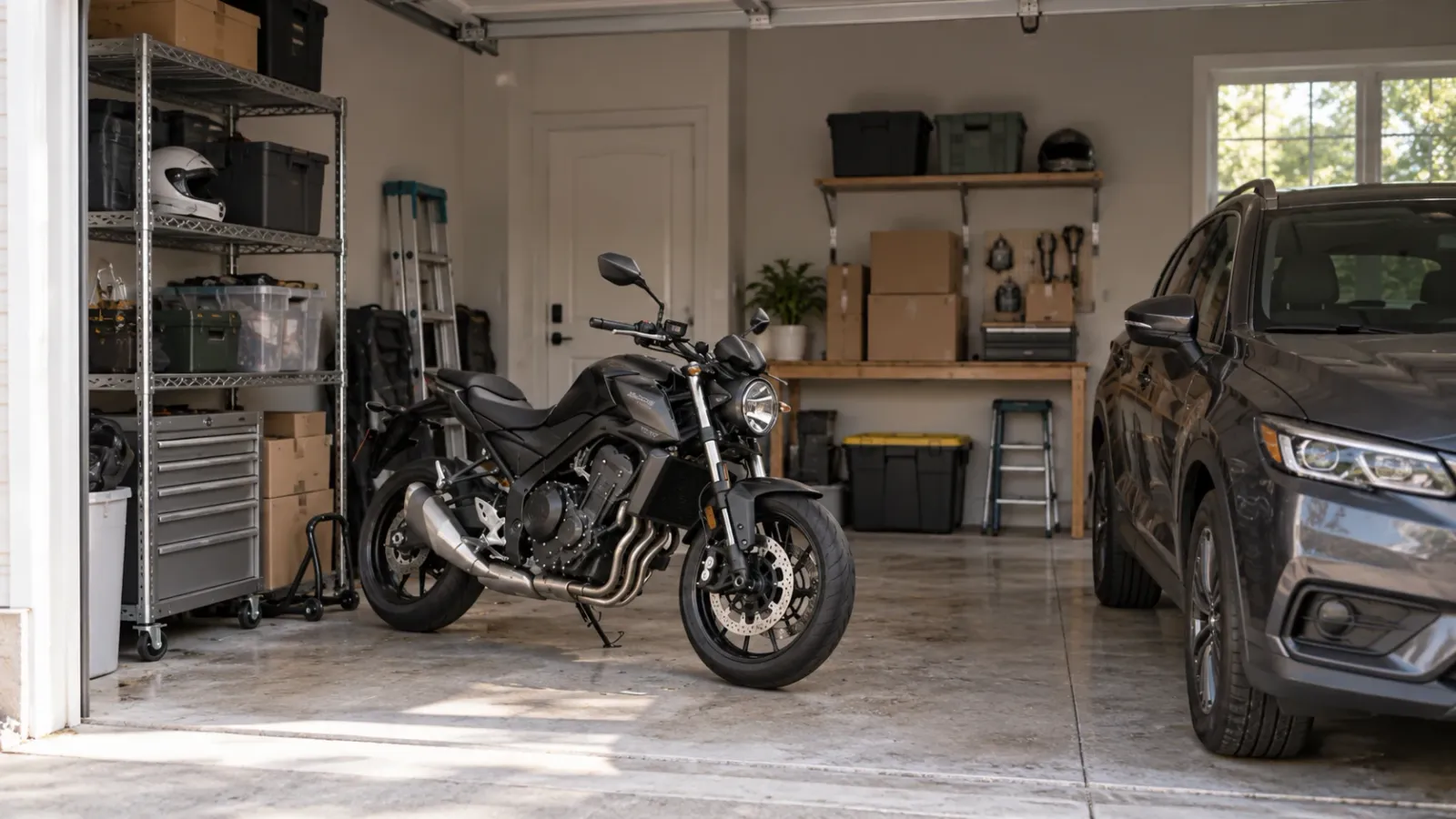
If you normally secure the bike to a fixed point, an indoor space without an approved anchor may still be a meaningful downgrade. If you use a battery maintainer, verify electrical access and whether residents may use it. If you use a cover, make sure there is enough space to put it on and remove it without interfering with neighboring vehicles.
Questions worth asking during a viewing
“I have one motorcycle. Where would it be parked?”
“Is motorcycle parking covered by my normal parking agreement?”
“Can a car and motorcycle share my assigned space?”
“Are chains or other security devices allowed?”
“Can I see the actual space and the route from the street to it?”
5. Check insurance and paperwork before the address changes
Tell your motorcycle insurer about the move and ask what information they need. Useful questions include when the new garaging address should take effect, whether the parking arrangement changes the policy, whether any security conditions apply, and whether the motorcycle is covered while being transported by somebody else.
Also check the registration, driver-licence and inspection requirements that apply at the new address. These vary by jurisdiction, so use the relevant authority rather than carrying over a deadline or rule from your previous address. If you are changing countries, start with our helmet laws by country guide, then confirm the local requirements.
6. Decide whether to ride or transport the motorcycle
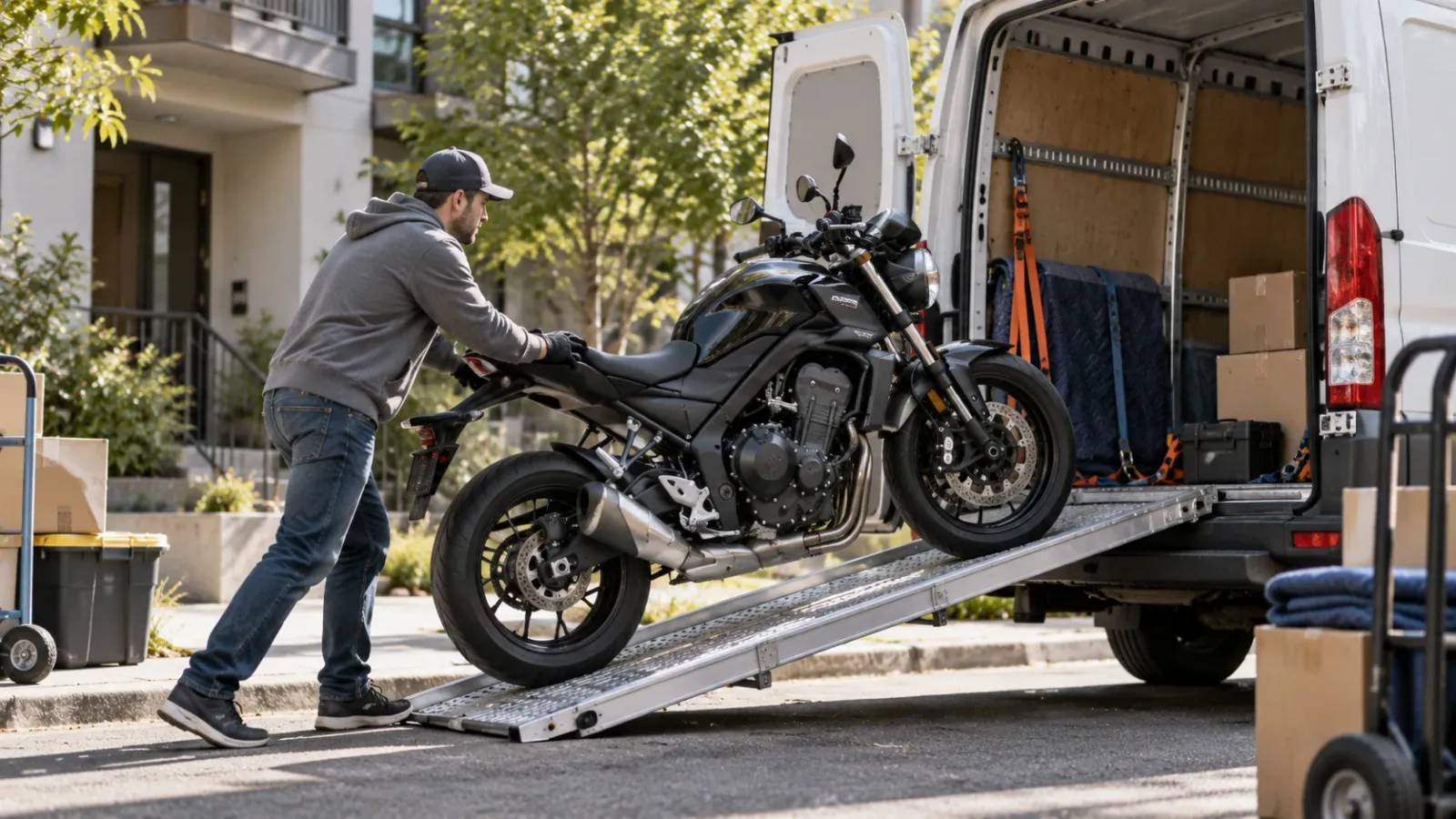
For a nearby move, riding the motorcycle to the new home can be straightforward. For a long-distance move, transport may be more practical. The key is to treat either choice as its own planned task rather than an afterthought on moving day.
If you ride it yourself
Consider the total distance, weather, available time, luggage and whether you are already driving another vehicle. If the ride becomes substantial, plan it as a trip: route, fuel, weather and rest time included.
If a company transports it
Before booking, ask whether transport is open or enclosed, whether pickup is door-to-door or terminal-based, what fuel level and preparation are required, how accessories are handled, how the bike is secured, what liability applies, and how condition is documented at collection and delivery.
Photograph the motorcycle immediately before handoff. Record both sides, front, rear, odometer and any existing damage, and keep the pickup paperwork.
If your household mover is carrying the motorcycle
Confirm explicitly that the motorcycle appears in the inventory and paperwork. For U.S. interstate moves, FMCSA states that movers must offer Full Value Protection and Released Value as liability options for household goods; understand what you select and ask how it applies to the motorcycle in the shipment.
7. Keep motorcycle essentials out of the moving truck
A motorcycle can arrive before your boxes—or after them. Keep the items you may need immediately with you rather than buried in the household shipment:
- motorcycle and spare keys;
- registration and insurance information;
- carrier or mover paperwork;
- helmet and normal riding gear;
- security keys or combinations;
- navigation or communication equipment you normally use.
If the bike was transported, inspect it before the first ride rather than assuming nothing changed in transit.
8. Do you actually need a different helmet after moving?
Usually, no. A change of address by itself is not a reason to replace a properly fitted, serviceable helmet. What can change is the type of riding you repeat every day.
| New riding pattern | Things worth checking when you next compare helmets |
|---|---|
| More slow, hot urban riding | Usable ventilation controls, removable liner and visor/fog-management options. |
| Much longer journeys | Fit over extended wear, pressure points, controls and the actual weight/configuration you will use. |
| More higher-speed riding | Stability, visor arrangement, ventilation controls and your overall wind/noise setup. |
| More cold or wet riding | Fog-management options, visor compatibility and controls you can operate with winter gloves. Our visor and anti-fog guide explains the options. |
| More dawn/dusk riding | Appropriate visor and glare-management options for those conditions. |
| More navigation/communication use | Manufacturer-approved communication compatibility and speaker placement. See our Bluetooth and intercom guide. |
| Glasses every ride | Glasses clearance during an actual fitting. |
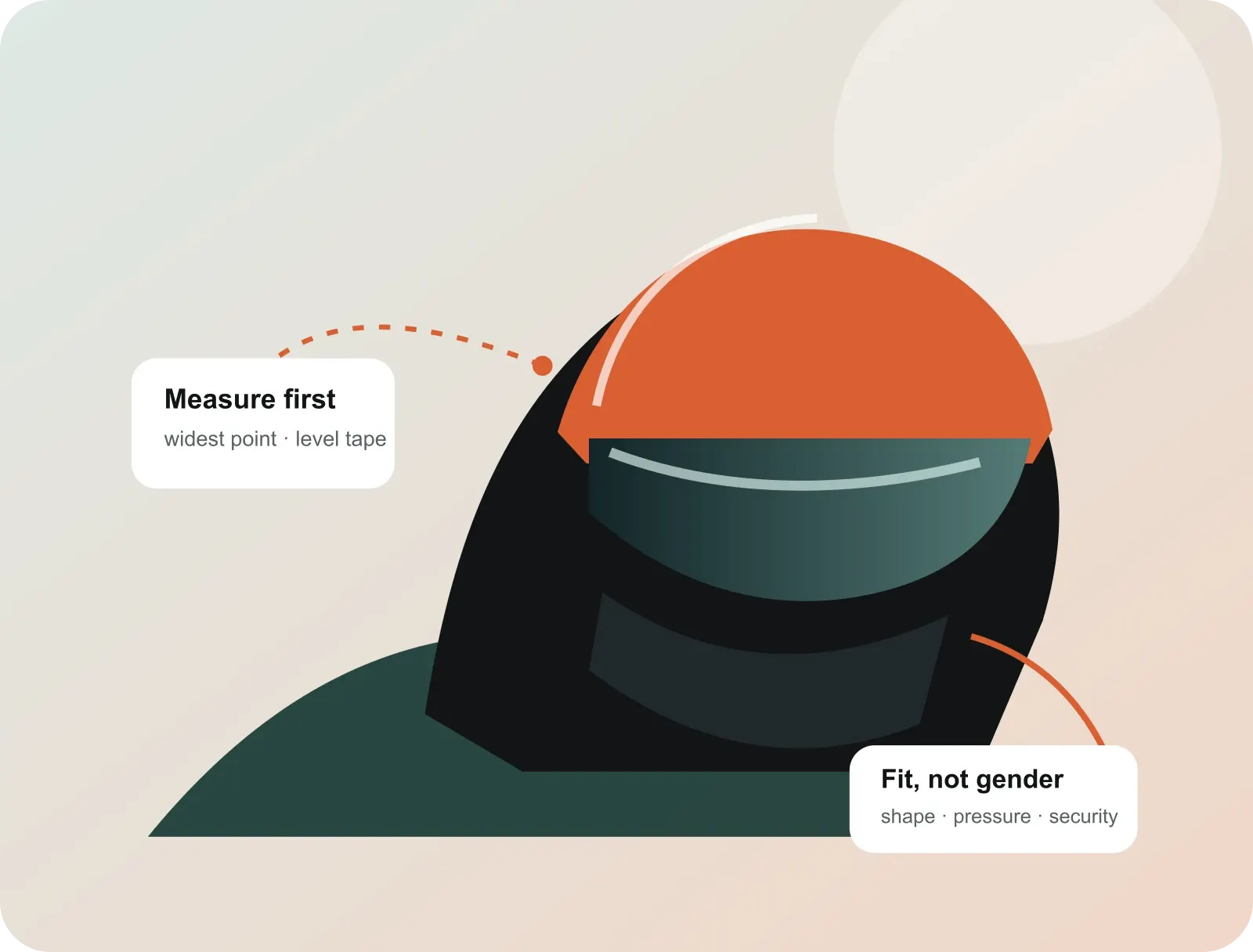
NHTSA advises checking head shape, circumference and pressure points. After buying a helmet, wear it for 30–45 minutes before your first ride to check for delayed hot spots. Helmet Advisor’s fit and sizing checklist turns that into a practical fitting sequence.
9. Do one trial commute before judging the new setup
Once you have access to the new home—and ideally before your schedule depends on the route—ride the expected commute at roughly the time you normally travel.
Pay attention to awkward entrances, road surfaces, congestion, alternative routes, actual parking access, door-to-door time and where you would stop in bad weather. One realistic trial often reveals details a map cannot.
10. Build your local motorcycle map
During the first week, identify a few useful places before you urgently need them:
- Fuel: a convenient station along normal routes.
- Tires: somewhere you could handle a puncture or replacement.
- Workshop or dealer: an appropriate service option.
- Inspection/testing: where applicable, the relevant facility.
- Alternative parking: useful if your normal garage becomes unavailable.
- Routine destinations: test parking at the places you actually use.
Use broad city and neighborhood research to understand the area, but verify exact motorcycle services, parking and building rules directly.
Motorcycle moving checklist
Before choosing the property
- Verify that motorcycles are permitted.
- See the actual parking location.
- Check the route into and out of the parking area.
- Confirm whether motorcycle + car can share a space.
- Check security-equipment restrictions.
- Compare the likely commute from each serious property.
- Check parking at work or other regular destinations.
Before moving
- Tell your insurer about the new garaging address.
- Check registration/address requirements.
- Decide whether to ride or transport the motorcycle.
- Get the transport arrangement in writing.
- Understand liability/coverage during transportation.
- Photograph the motorcycle before handoff.
- Keep keys, documents, helmet and essential gear with you.
After moving
- Inspect the motorcycle before the first ride.
- Ride the normal commute at a realistic time.
- Identify fuel, tire and service options.
- Verify parking at routine destinations.
- Update your riding requirements based on the actual commute.
- Reconsider helmet features only if your riding needs have changed.
Make the new routine work
For a rider, moving changes more than the location of the motorcycle. The useful questions are where the bike will stay, where you can park, what the daily journey actually looks like, how the motorcycle reaches the new home, and whether insurance or administrative requirements change with the address.
Research the neighborhood first, but finish the job at property level: see the parking space, test the route and verify the rules that apply to the exact address. Then ride the new routine before deciding that you need different equipment.
Sources and further reading
- NHTSA — Choose the Right Motorcycle Helmet: head shape, sizing and pressure-point guidance.
- FMCSA — Steps to Select a Mover: written estimates, interstate mover authorization and U.S. DOT information.
- FMCSA — Liability & Protection: Full Value Protection and Released Value for U.S. interstate household moves.
- Helmet Advisor — Motorcycle Helmet Fit and Sizing Checklist.
- StrollPlace — Neighborhood Finder, Compare Places, and Move Planner for broader relocation research.
Editorial note: This guide is documentation-based practical research, not legal, insurance or transportation advice. Rules and policy terms vary by jurisdiction and provider. Verify important requirements with the responsible authority, insurer, property manager or carrier.
Images are AI-generated editorial illustrations, not photographs of real people, properties or transport arrangements.