A flip-up chin bar tells you what the helmet can do in your hands. The approval label tells you which configurations were approved for riding. Under UN Regulation No. 22, P/J means the helmet meets the requirements in both its approved closed and open configurations. With the bar open, your chin and lower face are exposed. If you want the protection of the chin bar, close it and verify that it is locked before moving.
This guide helps you read the label, check the mechanism at a fitting, and decide whether dual approval matters to the way you ride. For the broader trade-offs in weight, convenience and fit, see our modular versus full-face guide.
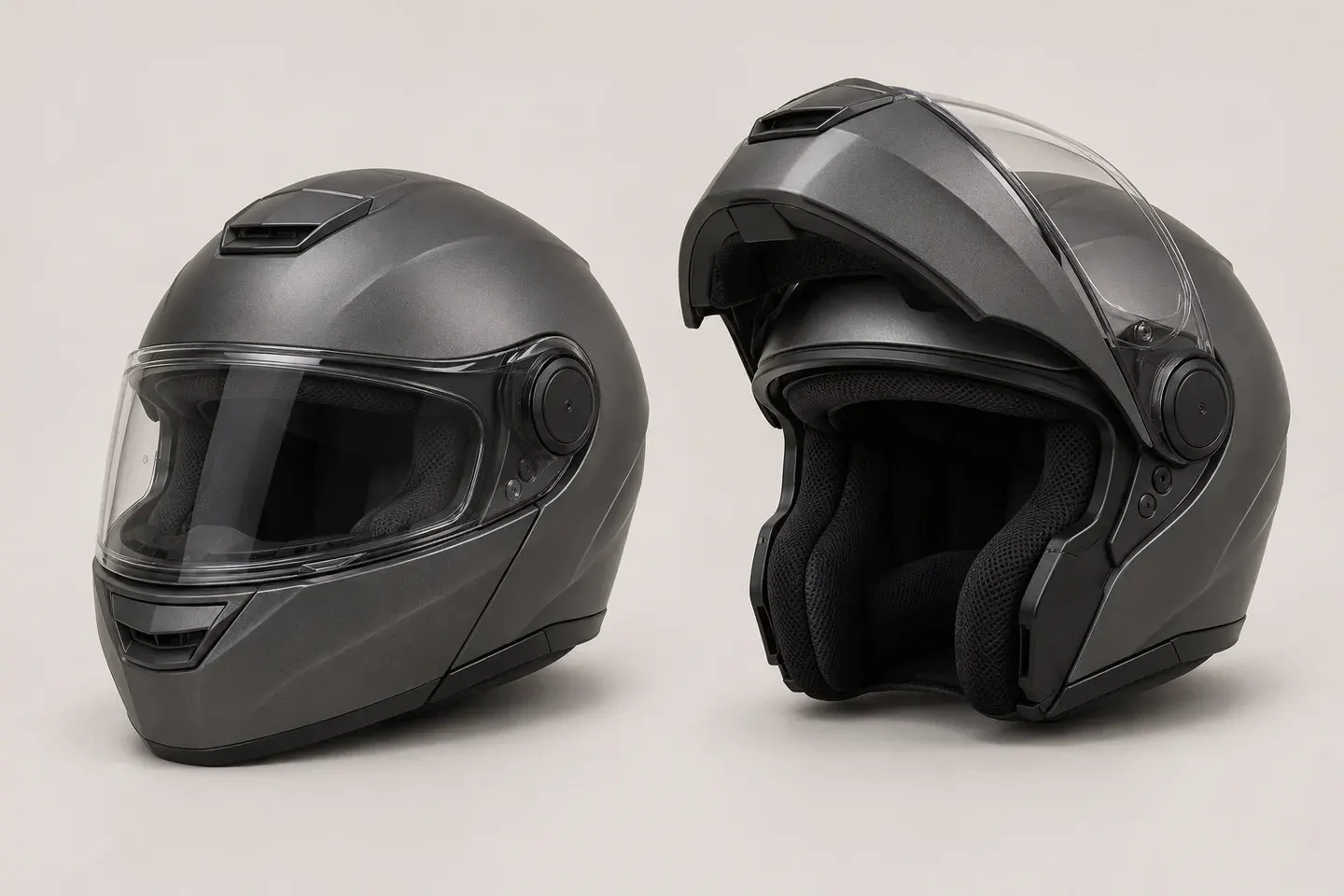
Hero image: AI-generated illustration of open and closed configurations. It does not depict a specific approved model.
What P, J, P/J and NP mean
- P: The helmet has a protective lower face cover in its approved configuration. A flip-front helmet marked only P should be ridden with the chin bar closed and secured.
- J: Open-face approval. There is no approved protective chin bar in this configuration.
- P/J: Approval covers the protective chin bar in position and the model's specified configuration with the bar raised, moved back or removed, as applicable. The owner's manual tells you which position applies.
- NP: The lower face cover is not intended to protect the chin from impacts. A face covering can look substantial without providing protective chin-bar performance.
These letters describe the configuration, while the approval number identifies the applicable series of the regulation. For example, 06 at the start of the approval number identifies the 06 series, commonly called ECE 22.06. The number beside the circled E identifies the country that granted the approval, rather than where the helmet was manufactured. See our ECE, DOT and Snell guide for the differences between systems.
Check the label on the helmet you will actually buy
- Ask for a clear picture of the approval label. On an ECE-approved helmet, look at the sewn label on the retention system. A listing that says “ECE 22.06” has not yet answered whether it is P or P/J.
- Match the model and market. Use the manual or manufacturer page for that version. A European product page does not establish how a US-market helmet of the same name was approved.
- Check what “open” means for that model. A bar that pauses halfway through its travel is not necessarily in the approved riding position. The instructions should show the intended position and any lock or selector that must be engaged.
- Check the places you ride. The approval describes the helmet configuration. The rules of the country, venue or organizer are a separate check. Start with our helmet laws guide and confirm the requirements for your destination.
What to check at the fitting
Ask the fitter to demonstrate both the chin-bar latch and the chin strap. These do different jobs: the latch secures the moving chin bar; the strap keeps the helmet on your head. Test both while stationary. Follow the manual's check for a fully latched bar, rather than relying on the sound of a click. Try the approved open position if you expect to use it, then return the bar to the locked closed position.
Check that you can fasten the strap, work the release and confirm closure with your normal gloves. Then wear the helmet closed while you assess pressure at the crown, room at the chin and clearance around your glasses. Raise the bar to check whether it makes putting the helmet on easier. The fit and sizing checklist covers the retention and pressure checks.
If the bar does not lock reliably, have the helmet inspected before riding. A laboratory latch result for that model, if available, cannot tell you the condition of the mechanism on your particular helmet.
Approval and SHARP latch scores answer different questions
Dual approval tells you which configurations met the applicable requirements. A SHARP latch score, where published, reports how often the chin bar stayed closed in SHARP's impact tests. SHARP tests flip-front helmets with the bar closed. A 100% latch score describes those tests; it is not a guarantee for every crash or a rating of open-position chin protection.
When is P/J worth looking for?
- You mainly open the bar at stops. Compare P-only flip-front and P/J helmets on closed fit, ease of operation and comfort. You can still use a flip-front design to make putting the helmet on easier or talk at a stop.
- You want the option of riding open. Look for P/J on the actual helmet and learn its approved open position. Decide whether you are willing to give up chin coverage in that position. When in doubt, keep the bar shut and locked.
- You expect to ride closed all the time. Try a fixed full-face helmet alongside the modular option. Compare fit and the controls you use on a normal ride; a hinge may add little value for you.
For a real-world example, Shoei Europe lists the European Neotec 3 as ECE 22.06 P/J and identifies an open-position locking system. Our C5 versus Neotec 3 comparison can help you build a fitting shortlist. Check the label and manual for whichever version you try.
Sources
- UNECE: UN Regulation No. 22, Revision 5 — section 2.7 defines the helmet types and section 5 covers approval markings.
- SHARP: Understanding J, P and P/J markings — approved positions and interpretation of latch scores.
- Shoei Europe: Neotec 3 — model-specific approval and open-position lock.